Ebook Free First, Break All the Rules: What the World's Greatest Managers Do Differently, by Marcus Buckingham Curt Coffman
If you really feel that this book is seriously matched to just what you require, simply locate it in far better condition. You could see that today publication in soft data systems are extended to make better methods to read a publication. Currently, it confirms that reading book is not kind of challenging means any longer. When you have actually got the First, Break All The Rules: What The World's Greatest Managers Do Differently, By Marcus Buckingham Curt Coffman, you have the appropriate selection as well as option. So, why don't you make it now and also right here?
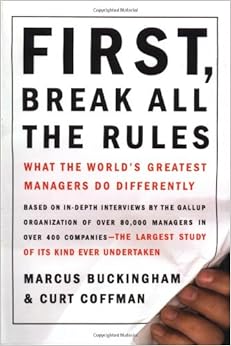
First, Break All the Rules: What the World's Greatest Managers Do Differently, by Marcus Buckingham Curt Coffman

Ebook Free First, Break All the Rules: What the World's Greatest Managers Do Differently, by Marcus Buckingham Curt Coffman
Anticipating a boosted ideas and also minds are a must. It is not just done by the people that have huge jobs. That's additionally not just carried out by the students or income earners in solving their duties troubles. Everybody has exact same possibility to seek and look forward for their life. Enriching the minds and also ideas for better way of living is a must. When you have determined the ways of exactly how you get the issues and also take the addressing, you should need reflections and also inspirations.
It is also what you could receive from the net connection. You are very easy to get every little thing there, especially for looking guide. First, Break All The Rules: What The World's Greatest Managers Do Differently, By Marcus Buckingham Curt Coffman as one of the referred publication to check out when vacations is additionally supplied in the site. We are the site that has many completed publication types and also styles. Lots of publications from numerous nations are served. So, you will not be tough to seek for more than a publication.
To overcome your daily problems, related to your jobs, this book can be read page by pages. Of course, when you have no deadline jobs, you will also need what offered by this book. Why? It serves something interesting to learn. When you really love to read, reading something, what you can enjoy is the topic that you really know and understand. And here, First, Break All The Rules: What The World's Greatest Managers Do Differently, By Marcus Buckingham Curt Coffman will concern with what you really need now and you need actually for your future.
Obviously, First, Break All The Rules: What The World's Greatest Managers Do Differently, By Marcus Buckingham Curt Coffman comes to be likewise a good reason of you to spend your free time for analysis. It is various with other publication that could need ore times to read. If you have actually been loving this publication, you could precisely get it as one of the analysis products and friends to go along with spending the time. Then, you could also get it as other excellent people locate and also read this book. From this situation, it is so clear that this publication is really should acquire as the referred publication because it appears to be improving book.
Amazon.com Review
Marcus Buckingham and Curt Coffman expose the fallacies of standard management thinking in First, Break All the Rules: What the World's Greatest Managers Do Differently. In seven chapters, the two consultants for the Gallup Organization debunk some dearly held notions about management, such as "treat people as you like to be treated"; "people are capable of almost anything"; and "a manager's role is diminishing in today's economy." "Great managers are revolutionaries," the authors write. "This book will take you inside the minds of these managers to explain why they have toppled conventional wisdom and reveal the new truths they have forged in its place." The authors have culled their observations from more than 80,000 interviews conducted by Gallup during the past 25 years. Quoting leaders such as basketball coach Phil Jackson, Buckingham and Coffman outline "four keys" to becoming an excellent manager: Finding the right fit for employees, focusing on strengths of employees, defining the right results, and selecting staff for talent--not just knowledge and skills. First, Break All the Rules offers specific techniques for helping people perform better on the job. For instance, the authors show ways to structure a trial period for a new worker and how to create a pay plan that rewards people for their expertise instead of how fast they climb the company ladder. "The point is to focus people toward performance," they write. "The manager is, and should be, totally responsible for this." Written in plain English and well organized, this book tells you exactly how to improve as a supervisor. --Dan Ring
Read more
From Booklist
The authors, both management consultants for the Gallup Organization, use the company's study of 80,000 managers in 400 companies to reach the conclusion that a company that lacks great frontline managers will bleed talent, no matter how attractive the compensation packages and training opportunities. With this in mind, they sought the answers to the follow-up questions: "How do great managers find, focus and keep talented employees." Using case studies, diagrams, and excerpts from interviews, Buckingham and Coffman guide us through their findings that discipline, focus, trust, and, most important, willingness to treat each employee as an individual are the overall secrets for turning talent into lasting performance. The book concludes with suggestions on how to become a great manager, including ideas for interviewing for talent, how to develop a performance management routine, and how to get the best performance from talented employees. Although this is clearly an infomercial for the Gallup Organization, it nevertheless offers thoughtful advice on the essential task of developing excellent managers. Mary Whaley
Read more
See all Editorial Reviews
Product details
Hardcover: 271 pages
Publisher: Gallup Press; 1 edition (May 5, 1999)
Language: English
ISBN-10: 0684852861
ISBN-13: 978-0684852867
Product Dimensions:
6.1 x 1 x 9.2 inches
Shipping Weight: 1.1 pounds (View shipping rates and policies)
Average Customer Review:
4.5 out of 5 stars
580 customer reviews
Amazon Best Sellers Rank:
#111,293 in Books (See Top 100 in Books)
I purchased this phone because of the other reviews about it and the specs: Android Lollipop, 13 mp camera, 16 gb on board memory, 2 gb of ram, Gorilla Glass 3, and the phone came with a screen protector, earbuds, and very respectable case which I am using. I am a Cricket Wireless subscriber and was able to just insert my SIM card and the phone worked immediately with no issues what so ever. I purchased and installed a 64GB micro SD card and inserted it as well. I did have a problem with the SD card install, I had to push it with a bit of force for contact between the phone and card to take place. It seemed like I had to push harder than I should. It is in and it works and the phone.The spec that was most critical to me was the dual SIM ability. I am going out of country for a couple months and wanted a phone that I could use to stay connected to family here with and also purchase an "Orange" pay-as-you-go SIM in Europe. Having the ability to have both SIMS in the phone was very appealing to me.Using the phone I've found it to work as a phone very well. The reception is good to very good and the sound is fine. I wear a hearing aid and am sensitive to poor quality sound and this passes muster for me. I've installed Pandora One and listen to music while doing yard work and have been able to pull in Pandora from a long distance from my router. The size of the phone is also a plus. I have installed the Kindle App and have read portions of a book on it with the phone and it is OK.If I were to have any issue with the phone it would be getting my fingers in front of the camera when I turn it horizontally to take a picture. I am getting used to finger/hand placement but it forces me to hold the phone by the edges when taking a picture horizontally and I am a bit concerned that I may drop it.I've owned many other Android phones that cost significantly more and find this phone to be of similar to better quality to more expensive phone brands and also the features of this phone outshine most others in this price range. I did a lot of research before buying this phone, comparing features, reading reviews, going to several phone stores to see what was out there, making sure it would work with my phone carrier (Cricket used to use a CDMA system but now as part of AT&T requires a GSM phone), etc.I've had it about a month now and If this were to get lost or stolen I would buy this phone again.
There are a few good common sense ideas in this book. For example: 1.It's hard to change people; 2. Make the most of an employee's talents instead of trying to fix their weaknesses; 3. Don't micro-manage; 4. A good way of doing something is not simply the opposite of a bad way. The authors then contend that these ideas go against conventional wisdom. I don't know what conventional wisdom they are talking about since it agrees with most of mine. But then again I went to an engineering school, not a business school. After presenting these ideas there is not much else in the book except a series of disconnected management anecdotes. Curiously most of these anecdotes are examples of bad management. This is in direct contradiction to idea 4 above, which the authors spent several pages discussing. I think the first example of good management was about halfway through the book when they started to talk about Southwest Airlines. (Actually if someone wants to write a good management book, do a case study on Southwest Airlines.) Also most of the examples deal with restaraunts, hotels, and banks with almost none from a high tech or software business. Finally I think (and this is conventional wisdom again) a good manager must be able to 1.Prioritize; 2.Organize. The authors say nothing of these abilities and obviously know little about them.
"This book, based on twenty years empirical data, you have to love that. After first reading this book in 2006, my reaction was "MAN! This is a validation of what my mentors showed me". I have had some GREAT mentors during my career, both in the military and later, as a civilian. They taught me how to see things outside of conventional wisdom (not merely ignore that wisdom). If I may now offer further review: The following will comprise of my impressions of the Conventional vs. Revolutionary Key Approaches, offered on pages 66 and 67 offered in FIRST BREAK ALL THE RULES (1999) by M. Buckingham and C. Coffman.Conventional Key: "Select a person based on his experience, intelligence, and determination". There is nothing wrong with this statement in of itself. Let's say that there is are two candidates, one external, and one internal for one Engineering Change Order Coordinator position and the enterprise software system being used is Oracle. The external candidate does not have experience with the specified software, however has written thousands of ECOs, as well as cause and effect reports for their department. The other candidate has experience with exact software, however only minimal similar report writing. If the manager chooses the internal candidate due to the software experience, it may work fine in the long run. It can prove to be a better selection tool for the manager to use the Revolutionary Key: "When selecting someone, they select for talent, not simply experience, intelligence, and determination". In this case, the external candidate has a proven talent for working with personnel from multiple departments, in order to complete tasks that come with ECO writing. This individual will may likely have skill sets can perhaps cross over with minimal system training.Conventional Key: "Set expectations by defining the right steps". Creating flowcharts to show the steps needed to complete a set of tasks is a good thing. Using the Revolutionary Key: "When setting expectations, they define the right outcomes, not the right steps", can prove better. Perhaps you still use Visio, but instead you reverse engineer the processes to find your prerequisites. Work the process backward, from your desired outcome, back to the start.Conventional Key: "Motivate the person by helping him identify and overcome weaknesses". This less politically correct method of evaluating an employee, still fits well for some of the workers that reported to me. Their request was for me to "Tell me what I am doing wrong, so I can fix it." Revolutionary Key: "When motivating someone, they focus on strengths not weaknesses". For the most part, this approach has been the norm for myself, and the people that worked for me. The reviews that I wrote were geared more towards professional development in fact. I will not manufacture a weakness in someone, when one is not present! With influence from a previous manager, I began to have group study with the shop, install, and service foremen. Instead of having them read a book, we each studied a chapter a week. Each week, a different person would be assigned the chapter, and would write, and hand out a worksheet with a set of questions a couple days before we met, and then the team would discuss the assignment.Conventional Key: "Develop the person by helping them learn and get promoted. Career path by default? There is a certain quaintness to the "paid your dues"Âpath. So, if the worker is one of the best, AND shows leadership potential, I would still recommend this process Revolutionary Key: When developing someone, they help him find the right fit not simply the next rung on the ladder. Truly a key point. Even if it is the "paid your dues path, finding there right fit, and then developing that individual to be able to handle the new level of responsibility.Talent: "A recurring pattern of thought, feeling, or behavior that can be productively applied." Three recurring patterns that I feel a supervisor should have, are Ethics, Responsibility, And Command. A fairly cut and dry selection for me, as my most important mentors in the military and in business, all have had these talentsFrom the Striving Talents Ethics: A clear understanding of right and wrong, which guides your actions. Perhaps it is not telling your subordinate to lie to a supplier, or customer. Or maybe it is not being willing to have a good-old-boy network where you have your favorite workers stay in your office for extended meetings after lunch or smoke breaks with you, while the other workers are breaking knuckles turning wrenches. It is neither fair to the company, which expects work to be done during the periods that payroll is expected to compensate, nor those busting knuckles.Thank you for this book, Mr. Buckingham and Mr. Coffman."
First, Break All the Rules: What the World's Greatest Managers Do Differently, by Marcus Buckingham Curt Coffman PDF
First, Break All the Rules: What the World's Greatest Managers Do Differently, by Marcus Buckingham Curt Coffman EPub
First, Break All the Rules: What the World's Greatest Managers Do Differently, by Marcus Buckingham Curt Coffman Doc
First, Break All the Rules: What the World's Greatest Managers Do Differently, by Marcus Buckingham Curt Coffman iBooks
First, Break All the Rules: What the World's Greatest Managers Do Differently, by Marcus Buckingham Curt Coffman rtf
First, Break All the Rules: What the World's Greatest Managers Do Differently, by Marcus Buckingham Curt Coffman Mobipocket
First, Break All the Rules: What the World's Greatest Managers Do Differently, by Marcus Buckingham Curt Coffman Kindle

Tidak ada komentar:
Posting Komentar