Free Ebook
. A job may obligate you to constantly enhance the expertise and experience. When you have no enough time to boost it straight, you could get the experience and also expertise from reading guide. As everybody knows, publication is popular as the home window to open the globe. It means that checking out publication will certainly give you a brand-new method to discover every little thing that you require. As the book that we will offer below,

Free Ebook
Success is a choice. It's exactly what many individuals say and suggest making others be doing well. When somebody chooses to be success, they will certainly attempt huge effort to realize. Lots of means are planned and also gone through. Absolutely nothing limited, but there is something that could b forgotten. Seeking for knowledge and experience need to remain in the plan as well as procedure. When you constantly a lot more these 2, you could complete your strategies.
That's no doubt that the visibility of this publication is really enhancing the viewers to constantly love to check out as well as review once again. The genre reveals that it will be proper for your study and also work. Also this is just a book; it will certainly give you a very big deal. Really feel the contrast mind before and after reviewing And also why you are truly fortunate to be below with us is that you locate the ideal location. It indicates that this place is meant to the fans of this kin of book.
From the book, you will certainly realize that reading is absolutely needed to do. It will assist you to obtain more priceless hanging out. By reviewing guides, your hung out will certainly not throw away incorrectly. You could locate what exactly you want and needs to observe. Here, the comes to be a choice to check out guide because it gives you the incredible functions of the life. Even it is only the rep are for getting this type of book, you might see how you could delight in guide specifically.
When other individuals are still waiting for the book available in the book shop, you have done the good way. By seeing this website, you have been 2 advances. Yeah, in this site, the soft file of the is listed. So, you will certainly not go out to have it as yours. In this site, you will certainly locate the web link and the link will lead you to get guide data straight.
Product details
File Size: 784 KB
Print Length: 263 pages
Publisher: OUP Oxford; Reprint edition (April 23, 2009)
Publication Date: April 23, 2009
Sold by: Amazon Digital Services LLC
Language: English
ASIN: B005G6O3QU
Text-to-Speech:
Enabled
P.when("jQuery", "a-popover", "ready").execute(function ($, popover) {
var $ttsPopover = $('#ttsPop');
popover.create($ttsPopover, {
"closeButton": "false",
"position": "triggerBottom",
"width": "256",
"popoverLabel": "Text-to-Speech Popover",
"closeButtonLabel": "Text-to-Speech Close Popover",
"content": '
});
});
X-Ray:
Not Enabled
P.when("jQuery", "a-popover", "ready").execute(function ($, popover) {
var $xrayPopover = $('#xrayPop_0B588C0A58D111E9A7AF70E915AD89A8');
popover.create($xrayPopover, {
"closeButton": "false",
"position": "triggerBottom",
"width": "256",
"popoverLabel": "X-Ray Popover ",
"closeButtonLabel": "X-Ray Close Popover",
"content": '
});
});
Word Wise: Enabled
Lending: Not Enabled
Screen Reader:
Supported
P.when("jQuery", "a-popover", "ready").execute(function ($, popover) {
var $screenReaderPopover = $('#screenReaderPopover');
popover.create($screenReaderPopover, {
"position": "triggerBottom",
"width": "500",
"content": '
"popoverLabel": "The text of this e-book can be read by popular screen readers. Descriptive text for images (known as “ALT textâ€) can be read using the Kindle for PC app if the publisher has included it. If this e-book contains other types of non-text content (for example, some charts and math equations), that content will not currently be read by screen readers.",
"closeButtonLabel": "Screen Reader Close Popover"
});
});
Enhanced Typesetting:
Enabled
P.when("jQuery", "a-popover", "ready").execute(function ($, popover) {
var $typesettingPopover = $('#typesettingPopover');
popover.create($typesettingPopover, {
"position": "triggerBottom",
"width": "256",
"content": '
"popoverLabel": "Enhanced Typesetting Popover",
"closeButtonLabel": "Enhanced Typesetting Close Popover"
});
});
Amazon Best Sellers Rank:
#513,465 Paid in Kindle Store (See Top 100 Paid in Kindle Store)
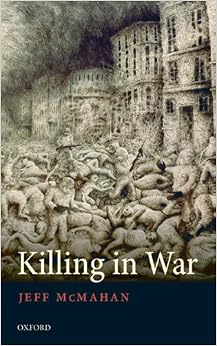
This is an excellent book on just war theory or the ethics of war. It touches on all major aspects of the current debates within the morality of war both the morality of going to war (jus ad bellum) and conduct in war (jus in bello). The major thesis is one that I don't find all that surprising but it maybe surprising to many others: that unjust combatants don't have the same moral standing as just combatants. Many of the traditional just war theorists, and how international law sees it as well, both just and unjust combatants have equal moral standing on the battle field and both are permitted to kill each other. But McMahan argues (persuasively) that all of the available arguments to support this claim are deficient in one way or another. McMahan takes a very "fine grained" approach to attribution of blame and responsibility in the conduct of war and also its causes, meaning that his approach seeks to make nuanced distinctions between the moral complexities of wars while many other theorists have used much coarser-grained approaches such as grouping all civilian non combatants together or all combatants together as to their moral standing, etc.Other important findings include: 1. That many of us are likely far more culpable and responsible for the unjust actions of our government in war than we often (would like to) believe and that this has important consequences for our moral standing. 2. That not all combatants, both within just groups and within unjust groups, share equal moral standings (some are far more culpable and responsible than others). 3. That some civilian non combatants are (though rarely) justifiably liable to be attacked by just combatants, and here McMahan gives a contemporary example and a historical example of non combatants that fits this criteria for this kind of moral liability.Where I felt the book could have done a little better was that there were some parts of it that was quite philosophically convoluted. Though still well written, these parts could have used some (preferably real) examples sprinkled in between the arguments. Very complicated moral nuances are distinguished and discussed between the different kinds of rights and circumstances that are relevant. They are examined in depth from every direction possible but the lack of examples in some parts makes those sections dry and seem too "ivory tower." But this is a minor quibble as the work is quite well written in general.McMahan (here and elsewhere) argues from analogy (as many just war theorists do) between the morality of personal self-defense and that of war. Much of his argument depends on a close analogy but I would also have liked for McMahan to talk more about the glaring dis analogy between the rare (perhaps only hypothetical presently) cases of military occupation without intent or reasonable likelihood of deaths or serious bodily injury to anyone on the just side. McMahan agrees that occupation of one's ancestral lands offer sufficiently good moral reason to kill potential or actual unjust occupiers. But if that seems to be at tension with laws and their moral foundation in self-defense for no state (except maybe Texas, Florida and a few other states) allows killing to defend property alone but only if the perpetrator intentionally threatens someone's life or gives reasonable threat of serious bodily injury is lethal self-defense allowed. If a foreign unjust power decides it only wants some other nation's land to occupy, perhaps for the resources on that land, but has no intent to physically harm any of the citizens of that land, then what is the reasoning behind allowing the citizens of that land to use deadly force to defend against the occupation? The import is that this could open up room for a defense of a weak kind of pacifism which McMahan does not discuss in depth. This question I think could be answered competently by McMahan or other just war theorists while maintaining the general analogy but it is one minor lacuna that kept me unsatisfied.
Actual rating 4.5Anyone seriously interested in the just war tradition is wrong not to be familiar with Jeff McMahan's work on the topic. In this work, McMahan goes after some sacred cows that virtually all non-pacifist writers about the ethics of war have taken for granted for centuries on surprisingly weak ground. Foremost among these is the idea of the moral equality of combatants; that is, that combatants on both sides of a given war are moral equals regardless of whether they are fighting for a just cause or an unjust cause.The traditional view has it that, upon becoming combatants, combatants abdicate some of their right not to be killed in exchange for an expanded set of permissible actions, namely, the right to kill. McMahan denies that combatants on the just side of a war actually do this. If their cause is just, he argues, why should it be more permissible to kill them than "innocent" civilians? After all, both are innocent in the relevant manner.I find McMahan is unbelievably presuasive in making this argument. If the book leaves anything to be desired it is that it is too narrow. We never really get a full-fledged account of justice of war. In fairness, the book never set out to do this. Still, I felt like a broader account would have been more fulfilling.
Outstanding title and a worthwhile read. delivered in a timely fashion. Aworhtwhile look into the phenomenon of killing in war. A good compliment to Dave Grossman's. "On Killing."
Jeff McMahan's book is a well-written discourse on an important topic that provides well-structured and considered problem of the individual warrier's responsibility for fighting in an unjust war.
NTR
Jeff McMahan challenges the reigning orthodoxies regarding the morality of killing in war. One of his main theses, for example, is that (usually) it is not permissible for combatants fighting without a just cause to attack combatants fighting with a just cause -- unjust combatants who do otherwise violate the rights of just combatants. The book is engaging, thorough, readable, creative, and well argued. I highly recommend it.
nope.
PDF
EPub
Doc
iBooks
rtf
Mobipocket
Kindle

Tidak ada komentar:
Posting Komentar