Download Regional Advantage: Culture and Competition in Silicon Valley and Route 128
Among the resources to get in this online collection is the Regional Advantage: Culture And Competition In Silicon Valley And Route 128 This site with this publication becomes one of the discovering centres to get the resources and also materials. Lots of publications from lots of sources, publishers, and also writers from worldwide are given. This service will certainly give not only the guidance books, the referrals, literature, as well as guideline publications are readily available to learn.
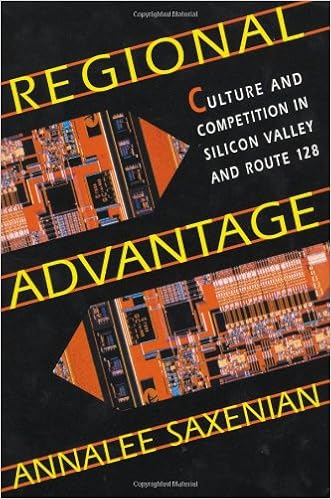
Regional Advantage: Culture and Competition in Silicon Valley and Route 128

Download Regional Advantage: Culture and Competition in Silicon Valley and Route 128
Ending up being a good person can be seen from the pastime as well as tasks to do each day. Many great activities are completed. However, do you love to read the books? If you don't have any wish to check out, it appears to be really lack of your finest life. Reading will not just provide you extra understanding however also give you the new better thought and mind. Lots of basic individuals always read such a publication everyday to spare even few times. It makes them really feel completed.
A referred will certainly be preferred to get the specific ways of how you make the deal of the circumstance. As just what we refer, Regional Advantage: Culture And Competition In Silicon Valley And Route 128 has several intentions for you to select as one of the resources. First, this is extremely attached to your issue now. This book also offers simple words to utter that you could digest the information easily from that publication.
To overcome your daily problems, related to your jobs, this book can be read page by pages. Of course, when you have no deadline jobs, you will also need what offered by this book. Why? It serves something interesting to learn. When you really love to read, reading something, what you can enjoy is the topic that you really know and understand. And here, Regional Advantage: Culture And Competition In Silicon Valley And Route 128 will concern with what you really need now and you need actually for your future.
In this situation, what should do after getting this site is so straightforward? Locate the web link and take it as your referral to visit the link of guide soft file. So you could get it completely. This book offers a remarkable system of how the book will affect the presence of the life structure. Regional Advantage: Culture And Competition In Silicon Valley And Route 128 is a way that could minimize your lonesome sensation when being in the lonesome extra time.
Review
A welcome addition to the growing literature on American high technology, offering fresh insights in a thorough...account of the economic and technological evolution of America's premier high-technology regions. (Richard Florida Science)Regional Advantage is an impressive demonstration of why new technologies and new markets both create and are driven by new business models and corporate structures. (Michael Stern San Francisco Chronicle)Saxenian's findings are important because they highlight the fundamental organizational practices behind California's economic successes in several key sectors, a reality dangerously ignored by many of the state's political and business leaders. (David Friedman Los Angeles Times)The best book I've seen at analyzing the secrets of Silicon Valley's success. And it shows why the valley's future remains bright even though costs are high. (James J. Mitchell San Jose Mercury News)This is scholarship at its best-thoroughly researched, elegantly written, a compelling story that's relevant to business executives and policymakers everywhere. (John Case Boston Globe)Over the past decade however there has been a growing interest in the role which territory (in the form of regions, industrial districts or innovative milieux)plays in fostering technical change and industrialinnovationÂ…One of the many virtues of this book is the way it penetrates beneath these superficial similarities, exposing a more complex, more telling set of differences which help to explain the very different fortunes of these regions in recent yearsÂ…what we have here is a well-researched, elegantly written and provocative book on a subject which should engage a wide array of disciplines, especially those with an interest in innovation and regional development. (Kevin Morgan Research Review)
Read more
About the Author
AnnaLee Saxenian is Dean of the School of Information at the University of California, Berkeley.
Read more
Product details
Paperback: 240 pages
Publisher: Harvard University Press; 50525th edition (March 1, 1996)
Language: English
ISBN-10: 9780674753402
ISBN-13: 978-0674753402
ASIN: 0674753402
Product Dimensions:
6.2 x 0.5 x 9.2 inches
Shipping Weight: 12.8 ounces (View shipping rates and policies)
Average Customer Review:
4.2 out of 5 stars
10 customer reviews
Amazon Best Sellers Rank:
#754,802 in Books (See Top 100 in Books)
Two major problems. The book is outdated. The book is half a book. It stops at the point where the issues become important. The statistical evidence for regional thinking has changed since this book was written. The book is useful to trigger the conceptual thinking, but it needs a rewrite and a completion.
Silicon Valley detractors are fond of saying that in this day of easy internet collaboration, video conferencing, and telepresence robots, Silicon Valley's comparative advantage in software and design is over, and it's only a matter of time before cheap housing and infrastructure elsewhere makes Silicon Valley obsolete or less attractive as a place to start companies or scale them. What's common amongst people who make such statements is that they've rarely had a substantial career in Silicon Valley (e.g.., working at 3 or more different firms at varying stage of development under different management teams), and more importantly, a lack of interest or knowledge in the history of Silicon Valley and Massachusetts's Route 128.Regional Advantage is a book well designed to alleviate most such ignorance. It covers the history of both regions stemming from World War 2 defense department funding and procurement, the rise of Route 128, which originally was much more developed than the area near Stanford, and the ultimate fall of Route 128 and rise of Silicon Valley. In the process it debunks the usual myths surrounding Silicon Valley, land use, and how "expensive housing, land, and high taxes" is unlikely to ever derail Silicon Valley.In particular, one advantage that the author notes is that Silicon Valley has always been geographically constrained: housing prices started going up as early as the 1970s, and people have always complained about unaffordable housing. The flip side of this has been density. Within the same 20 mile radius, you could switch jobs between multiple companies that are competing with each other for talent as well as product traction. Engineers back then were switching jobs at least every 2-3 years (sounds familiar to most Silicon Valley engineers). This high rate of job-switching is a disadvantage for employers (who even back then had to deal with bidding wars and a workforce that could walk out the door any time), but was also a benefit as it circulated ideas and shared social network contacts that made informality, contracts, and handshake deals the norm rather than slow, ponderous official methods.What's just as interesting are the ways that Route 128 failed: not only was land cheaper, the geographical sprawl enabled companies to hold on to employees longer. Furthermore, it was harder to get startup funding, or for employees to even notice them and want to join them. The preponderance of defense contracts that were easier to get also isolated the region from market competition, which led to longer design cycles and vertical integration.If the story behind the book was: "Silicon Valley went on an upward trajectory and never looked back", the book wouldn't have been as interesting and would have been over in a few pages. What I really liked about the book was the study of Silicon Valley in the 1980s, during which it lost the memory business to Japan and other areas, yet went on to regain the dynamic economy that it hadn't lost today. It turned out that during that period of scaling up, Silicon Valley ignored its advantages, and tried to go for Route 128-style vertical integration, keeping secrets from other competitors, and the like. The result wasn't good, but the story of how the valley recovered is also worth reading.What the book doesn't cover, however, is the modern era of how this story continues in software. Unlike manufacturing, software doesn't have standardized components, but depends much more on process. Companies like Google and Apple are much more secretive than the manufacturing equivalents of the days described in the book, though obviously the flow of people moving between companies do continue to circulate ideas. It would also be interesting to explore the migration of startups from Silicon Valley into San Francisco. The book could use an update along these lines, but I also expect the research required to do so would be much more intensive and difficult to get access to.All in all, this book is a great antidote for the usual Silicon Valley detractor story, while also providing good ideas for how a region could attain similar advantages for itself. Given how long the book's been out, however, I suspect that its lessons are much harder to apply than it seems. Nevertheless, given how quickly San Francisco grew as a startup hub, I wouldn't consider it impossible. It's just that the usual detractor cry of "lower taxes, cheaper housing, and more land" isn't going to do it at all.
This is an excellent reference work for the research academic who is interested in innovative organizational structures describing as it does the external forces of an organization in one of the most innovative business environments of the world. Saxenian brings out many brilliant insights that are lost in other published works on the Silicon Valley phenomenon. I used this book extensively for my PHD research to understand the dynamics of Silicon Valley. It ranks up there with Richard Florida's analysis of regional advantage in his work on 'creative classes' and John Seeley Brown's writings about 'the Valley'. Rightfully it takes a near center stage in Martin Kenney's excellent book of readings - Understanding Silicon Valley.
Pretty good book overall, but a little long winded. I felt like the information could have been condensed into half as many pages. That being said, it was interesting to see the cultural difference between Route 128 and Silicon Valley that led to Silicon Valley becoming the predominant tech hub. Overall, I would recommend it to anybody who is interested and doesn't mind a repetitive read.
This book was recommended to me by a VP at Sun Microsystems to explain why Silicon Valley happened [open-org-networks and strong entrepreneurial initiatives] and how other communities can learn from this success. The answers to why and why-not for a community are found embedded in the local or regional business culture. How close-minded is your town?
The book is written by a person who lived in the Route 128 area and in the Silicon Valley. Besides the great insights and fantastic scholarly work, the book reflects the experience of seeing the development of both regions, not only through the eyes of a scholar, but also through the experiences that can only be gained by "being there."
Contrary to one of the other reviewer's comments, the importance of this book is in showing precicely that it is not the "endemic" culture of Silicon Valley, but rather the innovative institutions and networked relationships in Silicon Valley that explains the region's success. A great contribution to the literature on embeddedness and network forms of organization.
saxenian argues that silicon valley's competitive advantage is the vast network of small firms that compose silicon valley and cross pollinate each other. she compares the valley to the route 128 area in boston which she classifies as detrimentally hierarchical, even puritanical.
Regional Advantage: Culture and Competition in Silicon Valley and Route 128 PDF
Regional Advantage: Culture and Competition in Silicon Valley and Route 128 EPub
Regional Advantage: Culture and Competition in Silicon Valley and Route 128 Doc
Regional Advantage: Culture and Competition in Silicon Valley and Route 128 iBooks
Regional Advantage: Culture and Competition in Silicon Valley and Route 128 rtf
Regional Advantage: Culture and Competition in Silicon Valley and Route 128 Mobipocket
Regional Advantage: Culture and Competition in Silicon Valley and Route 128 Kindle

Tidak ada komentar:
Posting Komentar